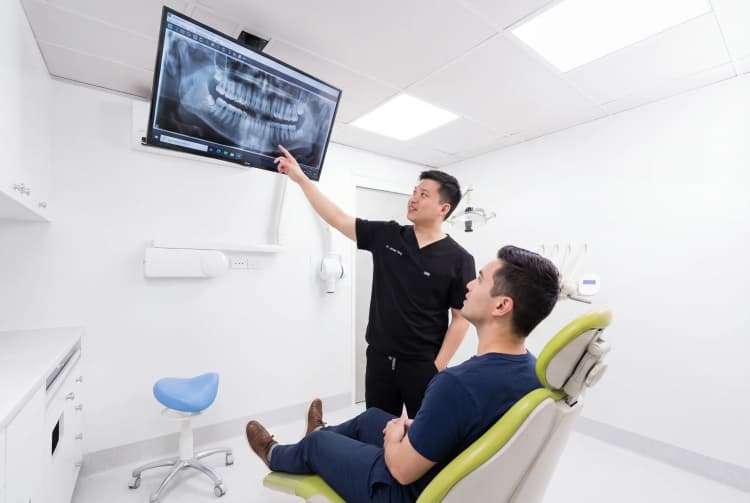

Can a cracked tooth be fixed without a crown?
Can a cracked tooth be fixed without a crown? It is one of the questions we are asked most often, usually by someone who has felt a twinge when biting, noticed a fine line in a tooth, or been told a cracked tooth will need a crown. The honest answer is that it depends on the crack, and quite often, especially when a crack is found early, the tooth can be repaired more conservatively. Here Dr Andrew explains how cracks behave, what decides the repair, and when a crown is still the right choice.
A cracked tooth does not automatically mean a crown
Do you need a crown if your tooth is cracked? Not automatically. A crack is a structural problem, and the right repair depends on how far the crack runs, where it is, how much sound tooth remains around it, whether you have symptoms, and the forces your bite puts on the tooth.
"Every cracked tooth is different," says Dr Andrew. "So we start from the same question every time: what is the least invasive treatment that will properly protect this tooth? Sometimes that is sealing and bonding the cracks and rebuilding the tooth. Sometimes it is a crown. The tooth tells us which."
The common types of cracked tooth
"Cracked tooth" covers quite a range. These are the types dentists commonly describe, from the most minor to the most serious:
- Craze lines: tiny cracks in the outer enamel only. They are very common in adult teeth and usually harmless.
- Chips and fractured cusps: a piece of the chewing surface breaks away, often next to a filling.
- A cracked tooth: a crack that runs from the chewing surface down toward the root. The tooth is still in one piece, but the crack can slowly lengthen.
- A split tooth: a crack that has travelled far enough for the tooth to separate into parts.
- A vertical root fracture: a crack that starts in the root and works its way up, often with few symptoms until later.
If your tooth is chipped, do you need a crown? Usually not for a small chip, which can often be smoothed or bonded. A broken cusp, or a chip that reveals a crack underneath, needs a proper look, because it is the tooth around the chip that decides what support it needs.
Signs of a cracked tooth to mention to us
How do you know if a tooth is cracked? Commonly, people notice:
- Sharp or erratic pain when biting, especially as you release the bite.
- Sensitivity to hot, cold or sweet foods that comes and goes.
- Discomfort that is hard to pin to a single tooth.
- A rough edge, or a fine line you can see or feel.
Some cracks cause no symptoms at all at first, and are picked up at a routine check. None of these signs confirms a crack on its own, so treat this list as things worth telling us rather than a way to diagnose yourself. The only way to know is to have the tooth assessed.
Why teeth crack: a strong outer shell and a flexible inner core
To understand how a cracked tooth can be repaired, it helps to know how a healthy tooth handles force. "The way the enamel and the dentine bond together gives the tooth both strength and a very strong outer shell," Dr Andrew explains, "but almost a flexible inner core to absorb the stresses of day-to-day chewing."
Enamel is hard but brittle. Dentine underneath is a little more flexible. Bonded together, they work as one unit. When a cavity is cut for a traditional filling that is plugged into the space, such as an older amalgam filling, that bonded unit is interrupted. "By cutting the hole, much of that strength is lost," says Dr Andrew, "and that is where we start to see cracks. Like a crack in a windscreen, it starts small and then it expands out."
This is also why a crack is worth attending to early. A small chip in a windscreen can often be repaired. Left for long enough, it tends to run across the glass, and then the whole windscreen has to be replaced. Teeth behave in a similar way.
What decides whether a cracked tooth needs a crown
When we assess a cracked tooth, these are the things we look at:
- How far the crack runs: whether it stays in the enamel, extends into the dentine, or reaches below the gum or into the root.
- Where it is: a crack across a cusp behaves differently from one running through the centre of the tooth.
- How much sound tooth remains: whether there is enough healthy enamel and dentine to bond a repair to.
- Your symptoms: including any signs that the nerve inside the tooth is involved.
- Your bite: the chewing forces on the tooth, and whether you clench or grind.
Cracked tooth: filling or crown? A traditional filling that simply fills a space may give limited bracing to a cracked tooth, which is why the choice is usually between a bonded repair that supports the tooth and some form of crown coverage. For the full comparison of a traditional filling, a BioClear restoration and a biomimetic crown, see our guide to crown or filling.
Fixing a cracked tooth without a crown: sealing and bonding the cracks
When a crack is caught in time and enough sound tooth remains, the tooth can often be repaired conservatively. If there is an old filling, it is removed first. Then, rather than cutting the tooth down, we prepare only where the cracks are. "We are just etching where the cracks are, nothing else," says Dr Andrew. "We are preserving the enamel that is there."
Bonding resin is then worked into the cracks. "It will seep into those cracks, and it will bond and hold the tooth together," he explains. The tooth is then rebuilt using materials chosen to mimic the dentine inside the tooth and the enamel outside it, which is the principle behind biomimetic dentistry: restoring the tooth in a way that follows its own natural structure.
Where the walls or cusps have been weakened, a BioClear restoration can take that repair further. It is a direct bonded rebuild, usually done in one visit, that can extend around vulnerable cusps and walls, almost like shrink-wrapping the tooth, so the restoration and the tooth work together as a more integrated unit. In selected deeper cavities, we may also seal the freshly prepared dentine straight away and add a fibre-reinforced inner core to help resist cracks.
Shrink-wrapping is an analogy, not a literal description, and it is not a promise that a tooth will never crack again. The extent of the crack, your symptoms, how much tooth remains and your bite still shape the outlook. For a real example, see our patient story on repairing a cracked tooth behind an old filling, where cracks spreading from an older amalgam filling were sealed and the tooth rebuilt.
When a crown or other treatment is still the right choice
Can a cracked tooth be saved? Many can, particularly when the crack has not reached below the gum or split the tooth apart. A crown is not always the first step, but for some cracked teeth it is the right one. "Conservative dentistry means doing no more than is needed," says Dr Andrew, "but also no less than is required to protect the tooth."
- A biomimetic crown may suit a tooth with too little foundation or height left, a severe crack or a heavy bite. It is made outside the mouth and bonded over the tooth, covering a planned portion or most of it, while still preserving as much healthy structure as we safely can. Our article on what a biomimetic crown is explains more.
- A conventional crown is still the safest choice for some teeth, for example when very little sound tooth remains or the tooth is not well suited to bonding. Our crowns and bridges page explains what that involves.
- Root canal treatment may be needed if a crack has reached the nerve and it has become irreversibly inflamed or infected. The tooth is then protected afterwards. No treatment can promise to prevent a root canal, but sealing and protecting a crack early aims to protect the tooth and its nerve. You can read more about root canal treatment here.
- Removing the tooth is sometimes the kindest option, for example when a tooth has split or the crack runs deep into the root. If that is where your tooth is, we will explain why and talk you through the options for replacing it.
Where a more conservative repair will properly protect a cracked tooth, we would rather keep the tooth structure you have. Studies have measured that preparing a tooth for a full crown removes roughly 63 to 72% of the tooth structure above the gum, and once it is gone it cannot be put back. Preserve first. Protect properly. That is the thinking behind our crown alternatives approach.
What happens if a crack is left?
Cracks in teeth do not heal on their own. Over time, a crack tends to lengthen with everyday chewing, and the tooth may eventually break. "What we don't want is the tooth to break in such a way that it needs to be removed," says Dr Andrew.
That is not a reason to worry, and not every crack needs treatment straight away. Many craze lines are simply monitored. It is just a good reason to have a crack looked at sooner rather than later, because a crack that is found early usually has more options, including the more conservative ones.
Been told a cracked tooth needs a crown?
It is completely reasonable to want to understand your options before you commit. At our Ipswich practice, we will look carefully at the crack, show you what we see, and talk you through every suitable option, from least to most invasive, including when a crown is genuinely the best way to protect the tooth.
Been told you need a crown? Call us on (07) 3281 6666 and ask for a second opinion appointment, or book an appointment online. You can also read more about our crown alternatives first.
Do I need a crown if my tooth is cracked?
Not automatically. It depends on how far the crack runs, where it is, how much sound tooth remains, whether you have symptoms and the forces your bite puts on the tooth. Many cracked teeth caught early can be sealed, bonded and rebuilt, but some still need a biomimetic crown or a conventional crown to be properly protected.
Can a cracked tooth be saved?
Many can, particularly when the crack has not reached below the gum or split the tooth apart. A split tooth or a crack that runs into the root often cannot be saved, and in that case removing the tooth may be the kindest option. We will tell you honestly which situation your tooth is in.
Can a cracked tooth be fixed with a filling?
A traditional filling that simply plugs a cavity may give limited bracing to a cracked tooth. A bonded repair that seals the cracks and supports the weakened walls, such as a BioClear restoration, is a different approach and may suit a cracked tooth in suitable cases. It depends on the individual tooth.
How do I know if my tooth is cracked?
Commonly, a cracked tooth causes sharp or erratic pain when you bite, especially as you release the bite, or sensitivity to hot, cold or sweet foods. Some cracks cause no symptoms at first. The only way to know is to have the tooth assessed.
What happens if I leave a cracked tooth?
A crack tends to spread slowly over time, a little like a chip in a windscreen, and the tooth may eventually break. If it breaks in the wrong place it may not be repairable. Having it looked at earlier usually means there are more options to choose from.
Will a cracked tooth need a root canal?
Not always. If a crack reaches the nerve and the nerve becomes irreversibly inflamed or infected, root canal treatment may be needed before the tooth is protected. No treatment can promise to prevent a root canal, but sealing and protecting a crack early aims to protect the tooth and its nerve.
Recent articles

Can a cracked tooth be fixed without a crown?
23 Sept 2026