Crown or filling? How to tell which your tooth needs
Crown or filling? If you have a tooth with a large old filling, a crack or a corner that has broken away, it is usually one of the first questions on your mind. Patients also hear us mention a traditional filling, a BioClear restoration and a biomimetic crown, and quite reasonably wonder whether these are three names, or three sizes, of the same thing. Here Dr Andrew explains the difference, and how we work out which one your tooth actually needs.
Not three sizes of the same treatment
When Emily from our front desk put that question to Dr Andrew on patients' behalf, his answer was simple: "Not quite. Think of them as three ways of solving different-sized structural problems."
Each option does a different job. In one sentence: a traditional filling repairs the space; a BioClear restoration rebuilds and supports more of the tooth; a biomimetic crown provides broader protection when the remaining foundation is not enough.
It is a little like repairs to a house. A small hole in a sound wall just needs patching. A wall that has started to crack needs bracing so it can keep carrying its load. And when the frame underneath is no longer reliable, you need broader support. The size of the hole matters far less than the condition of the wall around it.
So the real question is not "how big is the cavity?" It is "how much sound tooth is left, and how well can it support itself?" That comes down to the enamel and dentine that remain, any cracks, and the forces your bite puts on the tooth.
When a traditional filling is exactly right
"A basic or traditional filling is often ideal for a smaller cavity," Dr Andrew explains. "We remove the damaged area and bond filling material into that space. It replaces what is missing, but it usually stays mainly within the cavity."
For a small or moderate cavity in an otherwise strong tooth, a traditional filling is often exactly the right treatment. It is bonded, it is conservative, and it is often repairable later if needed.
Its limit shows up when the tooth around the cavity is already weak. If the surrounding cusps and walls are undermined, cracked or heavily restored, simply filling the cavity may provide limited bracing beyond that local repair. This is why "crown vs large filling" is not really a contest of size: a very large traditional filling in a weakened tooth may not give the remaining walls the support they need.
When a BioClear restoration rebuilds and supports more of the tooth
Can you get a filling instead of a crown? Sometimes, although often not a traditional one. When a tooth has lost more structure but still has enough sound enamel and dentine to bond to, a BioClear restoration may rebuild and support it without crown preparation.
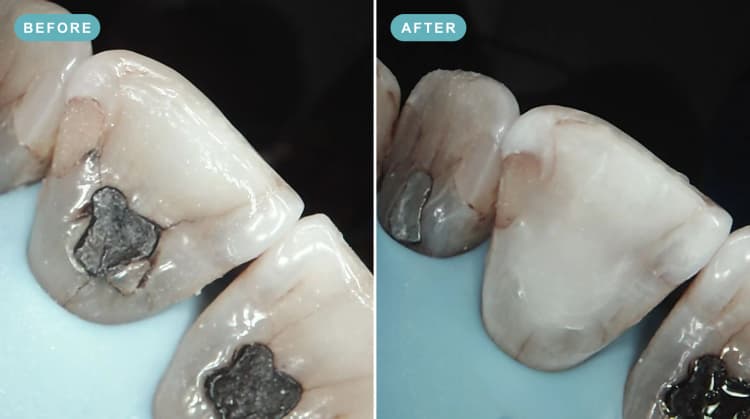
A BioClear restoration (sometimes called a BioClear filling) is a direct bonded rebuild, usually done in one visit. "We use special tooth-shaped matrices and a controlled injection-moulding technique so the resin closely adapts to the tooth," says Dr Andrew. "Where needed, we extend it around weakened walls, cusps or biting edges, almost like shrink-wrapping the tooth, to help support what remains."
"The difference is not only the amount of material. It is the preparation design, isolation, bonding, matrix, placement, shaping and bite adjustment working together. The aim is to preserve healthy tooth and rebuild it in one visit when that is the right option."
In practice, a BioClear restoration involves:
- Preserving sound enamel and dentine wherever it is clinically safe to do so.
- Smoothing sharp internal corners that can concentrate stress in the tooth.
- A clean, carefully isolated bonding environment, because reliable bonding depends on keeping the tooth dry.
- Anatomical matrices that shape the walls, contacts and contours of the tooth.
- Controlled placement or injection moulding so the resin adapts closely to the tooth.
- Bridging or wrapping vulnerable areas, such as weakened cusps or biting edges, when the design calls for it.
- Refining the shape and the bite so chewing forces are carried as safely as possible.
Shrink-wrapping is an analogy, not a literal description. All tooth-coloured resin shrinks slightly as it sets, BioClear resin included, and the whole bonded design is what aims to manage that stress. It also is not a promise that a tooth will never crack again: the extent of any crack, your symptoms, how much tooth remains and your bite still shape the outlook. For a real example of a cracked, heavily restored tooth being rebuilt rather than crowned, see our patient story on repairing a cracked tooth behind an old filling.
When a biomimetic crown gives broader protection
So when does a tooth need more than a direct rebuild? "When there is not enough reliable tooth foundation or height for a direct BioClear rebuild, or the damage and bite forces require broader protection," says Dr Andrew. "A biomimetic crown is made outside the mouth and bonded over the tooth, while still preserving as much healthy structure as we safely can."
A biomimetic crown is made from ceramic or composite and covers a planned portion, or most, of the tooth. It involves more preparation than a direct build-up, but it is designed conservatively for the protection the tooth needs. Our companion article on what a biomimetic crown is goes into more detail.
Onlay vs crown: an onlay is a partial-coverage restoration. It covers part of the tooth, usually the biting surface and one or more cusps, rather than the whole tooth above the gum. Studies have measured that partial-coverage restorations performed comparably to full crowns in the short term, although long-term evidence is still limited. A biomimetic crown sits in this same space: the coverage is planned around what the tooth needs, rather than reducing the whole tooth by default.
When a conventional crown is still the safest choice
A crown is not always the first step, but sometimes it is the right one. For some teeth, a conventional crown (or another treatment altogether) is still the safest choice, for example when very little sound tooth remains or the tooth is not well suited to bonding. When that is the case, we will say so plainly. Our crowns and bridges page explains what that treatment involves.
The reason we do not reach for a conventional crown first is simple. Studies have measured that preparing a tooth for a full crown removes roughly 63 to 72% of the tooth structure above the gum. Once that tooth is gone, it cannot be put back, so where a more conservative option will properly protect the tooth, we would rather keep it.
Crown or filling: the options side by side
Traditional filling. Repairs a localised area and sits mainly within the prepared cavity. Placed directly in the tooth. Suits a smaller defect with strong surrounding tooth. Often repairable.
BioClear restoration. Conservatively rebuilds and supports more of the tooth, and may extend around cusps, walls or edges where needed. Placed directly, usually in one visit, using a matrix-guided bonded workflow. Suits a damaged or heavily restored tooth that still has enough sound foundation to bond to. Designed to preserve sound tooth and avoid unnecessary crown preparation. Often maintainable or repairable, depending on the problem.
Biomimetic crown. Provides broader protection, covering a planned portion or most of the tooth. Made outside the mouth, then bonded to the tooth. Suits a tooth with too little foundation or height, extensive loss, severe cracks or a demanding bite. More preparation than a direct build-up, but still designed conservatively. Repair or replacement depends on the restoration and how it fails.
Conventional crown. Full coverage of the tooth above the gum. Still the safest choice for some teeth.
How we decide which your tooth needs
Every recommendation starts from the same question: "What is the least invasive treatment that will properly protect this tooth?" To answer it, we look at four things:
- The remaining tooth: how much sound enamel and dentine is left to reliably support bonding.
- Cracks and decay: how deep and extensive they are, and whether you have any symptoms.
- Isolation and bite: whether the tooth can be kept dry during treatment, and what chewing or grinding forces act on it.
- The repair pathway: which option protects the tooth now while keeping sensible options open for the future.
So does the right choice depend on the individual tooth? "Always," says Dr Andrew. "We choose the least invasive treatment that will properly protect it." Preserve first. Protect properly. That is the thinking behind our crown alternatives approach, which walks through how we take a second look at a tooth that has been recommended for a crown.
If you are curious how these options came about, from older-style fillings to today's bonded restorations, our piece on the evolution of restorative dentistry tells that story.
Here is the take-home decision guide we give patients weighing up these options, ready to print or save:


Been told you need a crown?
It is completely reasonable to want to understand your options before you commit, and a second opinion is a normal, sensible step, just as it is in medicine. At our Ipswich practice, we will look carefully at the tooth, show you what we see, and talk you through every suitable option, from least to most invasive.
Been told you need a crown? Call us on (07) 3281 6666 and ask for a second opinion appointment, or book an appointment online. You can also read more about our crown alternatives first.
How do I know if I need a crown or a filling?
It depends on how much sound tooth remains, whether there are any cracks, and the forces your bite puts on the tooth. A small cavity in an otherwise strong tooth usually suits a traditional filling. A tooth that has lost more structure may suit a BioClear restoration, a biomimetic crown or, for some teeth, a conventional crown. A careful examination is the only way to know for your tooth.
Can a filling be used instead of a crown?
Sometimes. If enough sound, bondable tooth remains, a BioClear restoration may rebuild and support the tooth in one visit without crown preparation. It is not simply a bigger filling, and it does not suit every tooth: some teeth still need crown coverage to be properly protected.
Is a BioClear restoration just a bigger filling?
No. The preparation design, isolation, bonding, anatomical matrix, injection-moulded placement and bite adjustment all work differently. Where needed, the restoration extends around weakened cusps or walls, almost like shrink-wrapping the tooth, so the restoration and the tooth can work together as a more integrated unit.
What is the difference between an onlay and a crown?
An onlay covers part of the tooth, usually the biting surface and one or more cusps, while a crown covers all of the tooth above the gum. Studies have measured that partial-coverage restorations performed comparably to full crowns in the short term, although long-term evidence is still limited. Which suits depends on how much of the tooth needs protecting.
When is a conventional crown still the right choice?
For some teeth, a conventional crown is still the safest choice, for example when very little sound tooth remains, the tooth is not well suited to bonding, or the bite calls for full coverage. If that is the case for your tooth, we will tell you plainly and explain why.
Why would I need a crown instead of a filling?
Usually because the remaining walls or cusps of the tooth are too thin, cracked or undermined to be supported by a repair that sits mainly inside the cavity. It is completely reasonable to ask why a crown has been recommended, and a good explanation should help you see what is happening with the tooth.
Recent articles


Repairing a cracked tooth behind an old filling
17 July 2026