Repairing a cracked tooth behind an old filling
This is a real case, shared anonymously with the patient's blessing. It answers a worry a lot of people have when they hear the words cracked tooth: does this mean a crown, or worse, losing the tooth? Often the answer is no. Here it is, with Dr Andrew's perspective and the actual before and after photos of the repair.
The problem: cracks starring out from an old filling
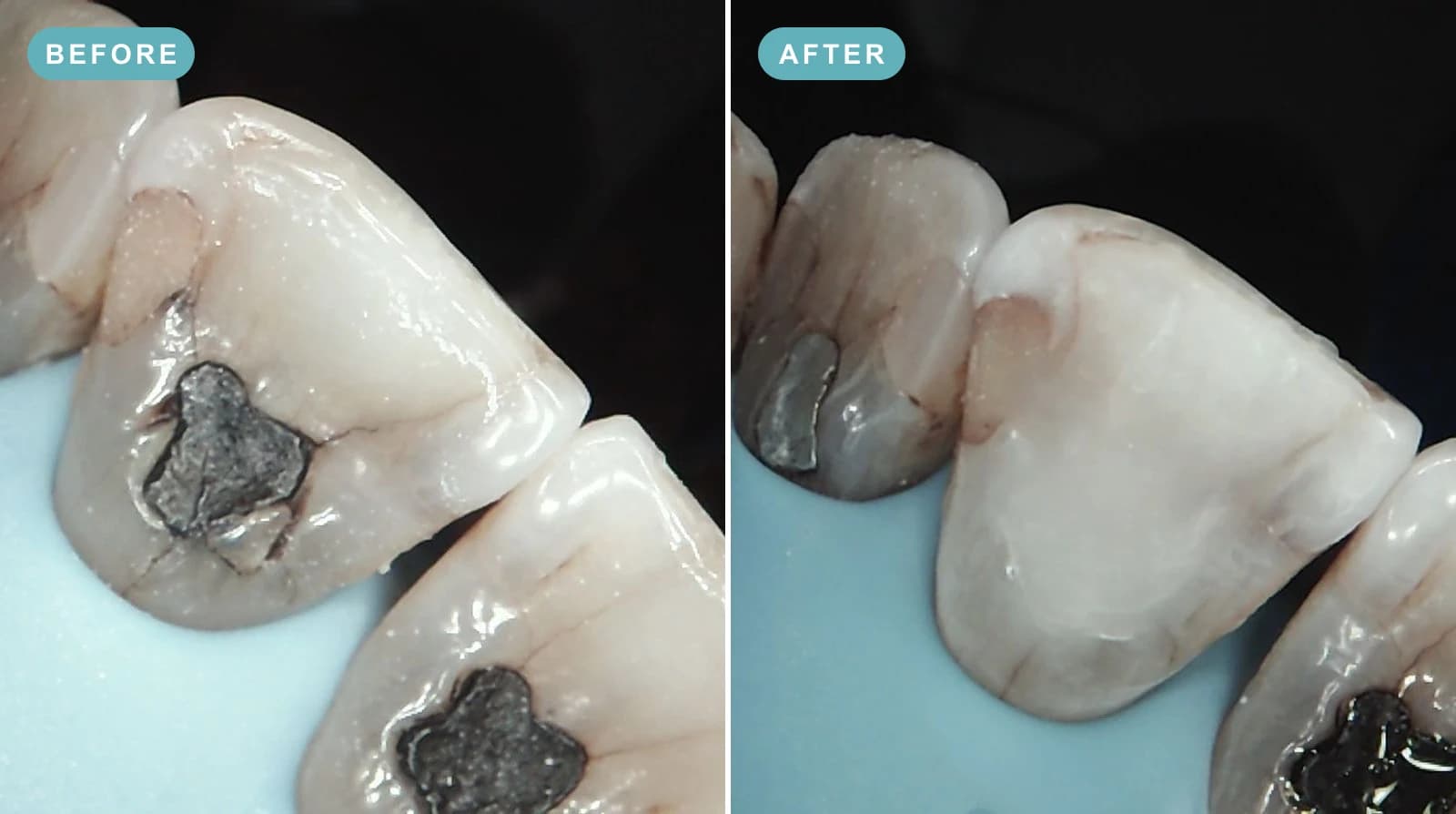
The before photo shows an old-style amalgam filling behind the upper front teeth, placed decades ago. You can see fine cracks starring out from it, radiating away from the edges of the filling. This has happened slowly over many years. A crack like this behaves much like a chip in a windscreen: it starts small, then gradually spreads out. Left alone, these cracks keep propagating through the tooth until it can no longer withstand the load and breaks. What we most want to avoid is the tooth breaking in a way that means it has to be removed.
Why it happens: the tooth was weakened when the hole was cut
An old filling like this is essentially plugged into a hole that was cut into the tooth. It fills the space, but it does not restore the tooth's structural integrity. In a natural, healthy tooth the enamel and the dentine are bonded together and work as one: the enamel is a very strong outer shell, while the dentine underneath is a more flexible inner core that absorbs the stresses of everyday chewing. Cutting the hole for the original filling removes a good deal of that built-in strength, and once that strength is gone, cracks tend to begin. It is worth saying that an old amalgam filling does not need to come out simply because it is old. In this case it is being removed because cracks are actively starring out from it, not because of its age. You can read more about how repair has moved on from those older fillings in our piece on the evolution of restorative dentistry.
The conservative repair: seal the cracks, keep the tooth
The good news is that a tooth like this can often be repaired conservatively. First we remove the old amalgam filling, without cutting away any more healthy tooth structure than we have to. Then we prepare the tooth with what we call a micro-etch, a gentle preparation applied only where the cracks are and nowhere else, so the existing enamel is preserved. Bonding resin then seeps into the cracks, sealing them and holding the tooth together.
From there we rebuild the tooth using materials chosen to mimic the dentine inside the tooth and the enamel on the outside, bonded together so the repair works as one unit with the natural tooth. In other words, we are mimicking the biology of the tooth to return its strength and integrity. This is the same tooth-preserving, biomimetic thinking behind the bonded repairs we favour, and it is why a cracked tooth does not automatically call for a crown. If you would like the deeper why behind rebuilding a tooth this way rather than crowning it, our companion article on what a biomimetic crown is walks through it, and a crown still has its place for teeth that genuinely need one.
The result
The after photo shows the completed repair. The cracks have been sealed and bonded, all of the existing tooth structure has been preserved, and material has been added to bond the tooth and return its strength. Because it keeps so much of the natural tooth and bonds it back together, this kind of repair gives the tooth the best chance of lasting well into the future. It is a conservative, tooth-preserving alternative to crowning or extracting a cracked tooth, when the problem is caught in time.
A nice footnote to this one: there are two teeth either side of the one we repaired, and the patient has already booked in to have those restored in the same way.
Talk to us about a cracked tooth or an old filling
If you have a cracked tooth, or an old filling you are wondering about, the sooner we take a look the more options there usually are. Removing an old filling and sealing the cracks early can often preserve a tooth that might otherwise be lost. For a wider guide to the types of crack, the signs to look out for and when a crown is still needed, see can a cracked tooth be fixed without a crown. If it is the filling rather than the tooth that has broken, our guide explains what to do when a big old filling breaks. Call us on (07) 3281 6666 or book an appointment online, and we will assess the tooth carefully and talk through the most conservative way to look after it.
Can a cracked tooth around an old filling be repaired without a crown?
Often, when it is caught in time. Cracks radiating from an older amalgam filling can often be repaired by removing the filling, sealing and bonding the cracks and rebuilding the tooth, rather than crowning it. Some teeth like this still need a crown, so it depends on a proper look at the individual tooth.
Why repair cracks around an old filling early?
Because a crack tends to keep spreading over time, much like a chip in a windscreen, until the tooth breaks, and at that point it may need to be removed. Repairing it while the crack is still contained gives us the best chance of keeping the natural tooth.
Should I replace an old amalgam filling just because it is old?
Not on age alone. A sound old filling that is doing its job can usually be left where it is. It is when cracks start radiating out from it, or there is decay or breakdown around it, that removing and repairing the tooth is worth considering. The decision is about what the tooth is doing now, not the age of the filling.
What is a biomimetic, tooth-preserving repair?
It means rebuilding the tooth with materials chosen to mimic natural dentine and enamel, bonded together so the repair and the tooth work as one unit and the tooth's strength is returned. The aim is to keep as much healthy tooth structure as possible and remove no more than is necessary.
What does the appointment involve?
The old filling is removed conservatively, without cutting away any more healthy tooth than needed. Only the cracks are then micro-etched and sealed with bonding resin, and the tooth is rebuilt in the chair with materials that mimic dentine and enamel. It is done to preserve the tooth rather than replace it.
Recent articles



Why do crowns fail, and how long do they last?
24 Sept 2026