Catching tooth decay early with magnification
This is a real patient story, shared anonymously with the patient's blessing. We think it raises a question a lot of people quietly wonder about: if I see a dentist regularly, how can something still be missed? Here it is, with Dr Andrew's perspective on why a thorough examination matters and how we treat small problems early.
A routine visit, and a closer look
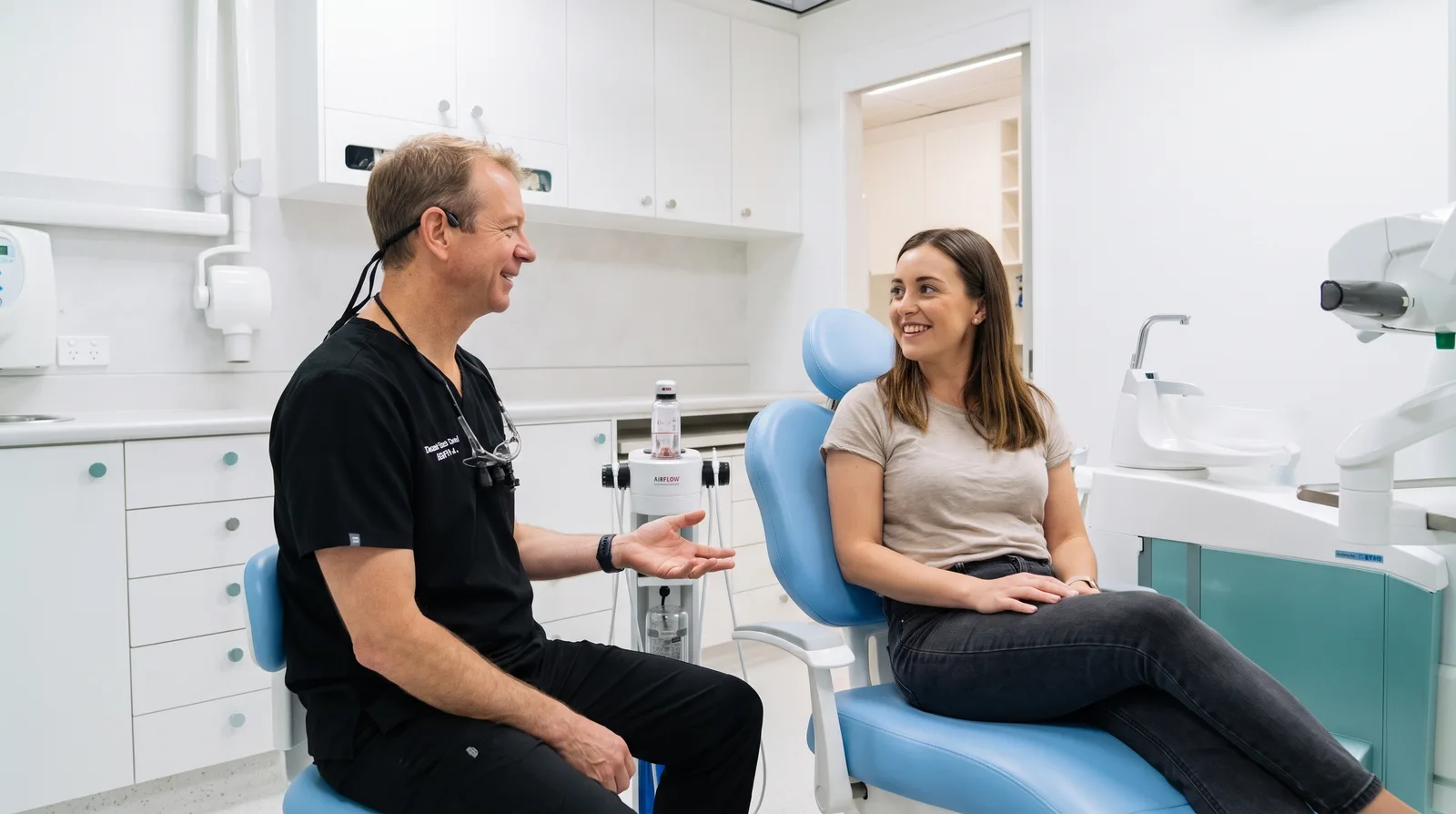
A young woman in her twenties came in recently for a check-up and clean. It was her first visit with us, referred through her family, so we treated it as a full new-patient examination rather than a quick look. She had seen a dentist every six months for a long time, had completed orthodontic treatment locally, and looked after her teeth well.
She also had a couple of retained baby teeth, which is more common than people realise. She knew they were there, and the plan we agreed was a sensible one: preserve them for as long as they are doing their job, monitor them over time, and have a clear replacement option ready for when they eventually need to come out.
What stood out during the examination was that, despite those regular visits, there was some straightforward preventive work that had not yet been done. There were areas of enamel wear and small notches at the gumline, particularly on the baby teeth we most wanted to protect. And at the back, some deep grooves that had been sealed in the past sat alongside other grooves that were deep, heavily stained, and showing early decay. Using my magnifying loupes, these areas were easy to see.
Prevention fillings: sealing a small problem early
The recommendation I made was a set of conservative prevention fillings. Using biomimetic techniques, the material is bonded into both the enamel and the dentine so that it works together with the tooth as a single unit. That seals the vulnerable groove or worn area, reinforces the tooth, and helps keep decay from getting a foothold. The idea is to look after a small problem now, with minimal drilling, rather than waiting until it becomes a larger repair.
Where decay is already present, I remove it carefully and conservatively. I use what is called a decay-indicating gel, which stains any remaining decay so I can be confident it has all been cleaned away before I bond and seal the tooth. Removing exactly what needs to go, and no more, is central to a conservative, tooth-preserving approach. You can read more about that thinking in our companion piece on the value of catching problems early.
"Why didn't my previous dentist find this?"
These were thoughtful, well-informed patients who had done their own reading, and they asked a fair question: how come this had not been picked up before? The honest answer is not that anyone had done anything wrong. Early wear and decay in a deep groove can be genuinely hard to see with the naked eye. Magnifying loupes enlarge and brighten the view, so those fine early changes stand out more clearly. Not every dentist works with loupes, and a thorough new-patient examination is also a chance to look at everything with fresh eyes. Different tools and a fresh, unhurried look simply make it easier to spot small things while they are still small.
"Why has decay appeared between check-ups?"
They also asked why decay seemed to have appeared so suddenly, from one check-up to the next, when nothing much had changed in how they looked after their teeth. It is a reassuring answer: decay does not usually arrive in a sudden jump. It develops slowly and quietly over time, and a closer look often simply catches it a little earlier in that process. It did not reflect a sudden spike in their risk. Regular check-ups and x-rays where appropriate are exactly how we keep an eye on these gradual changes and act on them early.
"Does xylitol chewing gum help?"
They had read that chewing gum containing xylitol can help reduce decay risk, and wondered whether they should be using it. It is a reasonable question. Xylitol can reduce the activity of the bacteria that contribute to decay, so it does have a place. It tends to be most useful for people with a genuinely higher decay risk, for example those with a dry mouth from certain medications or health conditions, or those who regularly have sugary or acidic drinks.
In this patient's case, it was not necessary. They were brushing well, flossing, using a fluoride toothpaste, and keeping sugary and acidic drinks to a minimum, and those habits are two of the biggest factors in keeping decay risk low. Once the preventive work was done, there was no high decay risk to manage. The best tools for most people remain the simple ones done consistently: good brushing, cleaning between the teeth, and being mindful of how often sugary and acidic drinks pass the lips. Our preventive care is built around exactly those foundations.
The takeaway
Seeing a dentist every six months is a genuinely good habit, and this patient had kept it up faithfully. The point of her story is simply that the quality of the examination matters as much as the frequency. A thorough, unhurried look, helped along by magnification, gives us the best chance of finding small changes early, and a conservative prevention filling lets us protect the tooth before a minor issue turns into a major one.
Here is the take-home guide we give patients after this kind of visit, ready to print or save:


Talk to us
If you are due for a check-up, or you would simply like a thorough second look at your teeth, we would be glad to help. Call us on (07) 3281 6666 or book an appointment online, and we will give you a careful assessment and talk through the most conservative way to look after your teeth.
Why didn't my dentist find my cavity sooner?
Often it is simply that early decay in a deep groove can be genuinely hard to see with the naked eye, not that anything was done wrong. Magnifying loupes enlarge and brighten the view, so those fine early changes stand out more clearly, and a thorough new-patient examination is also a chance to look at everything with fresh eyes. Different tools and an unhurried look make it easier to spot small problems while they are still small.
Do magnifying loupes help a dentist find decay?
They can help a great deal. Magnifying loupes enlarge and brighten the view of your teeth, so fine early changes in a deep groove or near the gumline are easier to see. They do not replace a careful examination or x-rays, but they are a useful extra tool for picking up small problems while they are still small.
What is a prevention filling?
It is a small, conservative restoration placed early, before decay has a chance to spread. Using biomimetic techniques, the material is bonded into the enamel and dentine to seal a vulnerable groove or worn area and reinforce the tooth. The aim is to protect the tooth with minimal drilling, rather than waiting until a larger repair is needed.
Can you keep baby teeth as an adult?
Sometimes, yes. If an adult tooth never formed underneath, a baby (primary) tooth can occasionally remain in place and keep working for many years. Where that is the case, we focus on protecting it and monitoring it over time, and we plan ahead for a replacement option for when it eventually does need to come out.
Recent articles



Why do crowns fail, and how long do they last?
24 Sept 2026